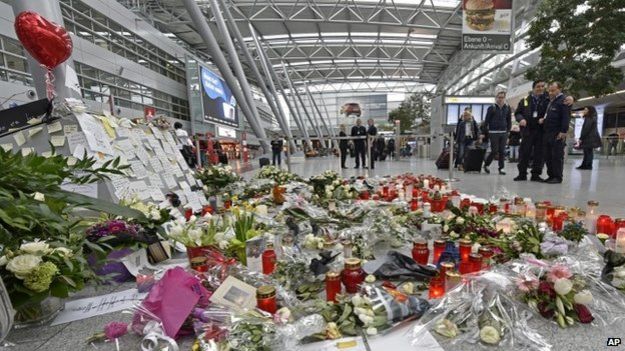
 Candles and flowers were left at Duesseldorf airport in memory of the victims
German prosecutors said on Monday that Lubitz had received treatment for "suicidal tendencies" before completing his training.
But Lufthansa said his medical records were subject to doctor-patient confidentiality and it had no knowledge of their contents.
The company has set aside an additional $300m (€280m; £200m) to cover possible costs arising from the crash.
The money is separate from the $54,250 available to the relatives of each passenger to cover short-term expenses.
Airlines are obliged to compensate relatives for proven damages of up to a limit of about $157,000, regardless of what caused the crash. Higher compensation is possible if an airline is held liable.
None of the victims' bodies were found intact after the plane's 700km/h (430mph) impact, but different strands of DNA have been identified.
French President Francois Hollande said on Tuesday that all 150 victims would be identified by the end of the week.
Speaking at a joint news conference with German Chancellor Angela Merkel in Berlin, Mr Hollande said "exceptional scientific work" had been carried out by the recovery team.
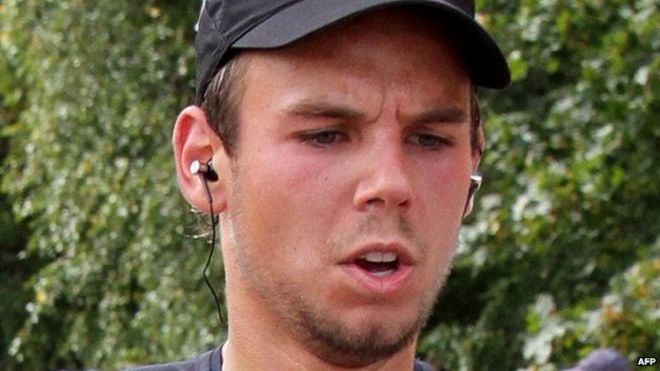
- Started training in 2008, at Bremen and Arizona. Training was interrupted for some months - but he later passed all tests and was deemed fit to fly
- Working as co-pilot, or first officer, since 2013. Appeared pleased with his job
- Lived in town of Montabaur, near Frankfurt, reportedly with his parents. Kept a flat in Duesseldorf and had many friends
- Facebook profile suggests the active lifestyle of a keen runner, with an interest in pop music
-
What drives people to murder-suicide?
-
The victims of the Germanwings plane crash
-
Germanwings: Unanswered questions
-
Flight 4U 9525: The final 30 minutes
-
Germanwings crash: Counting the cost
-
Who was co-pilot Andreas Lubitz?
-
Alps plane crash: What happened?
-
'We knew there would be no survivors'
-
How are cockpit doors locked?
-
School group on board crashed A320

No comments:
Post a Comment