We cover:
Current Events
Suicide Awareness
Suicide Prevention
World News
COVID
Mental Health Awareness
Mental Illness
Anxiety
Depression
Global Reset
Market Crash
End Days
Currency
TRUMP
NESARA GESARA
Digital Currency
Bitt Coin
Dinar
International News
Economics
Global Currency Reset
Crypto Currency
Currencies
Who keeps buying California's scarce water? Saudi Arabia
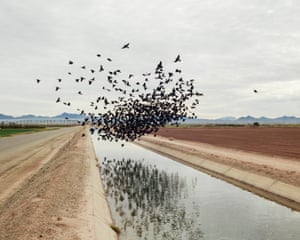
Red-winged blackbirds over an irrigation ditch in Blythe, California.
Photograph: Trent Davis Bailey/The Guardian
Saudi-based Almarai owns 15,000 acres of an irrigated valley – but
what business does a foreign food production company have drawing
resources from a US desert?
by Lauren Markham, photographs by Trent Davis Bailey
Four
hours east of Los Angeles, in a drought-stricken area of a
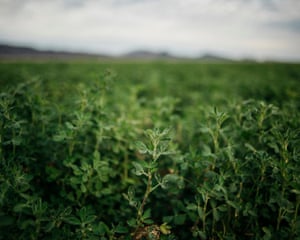
drought-afflicted state, is a small town called Blythe where alfalfa is
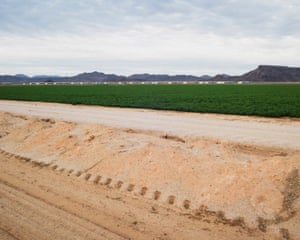
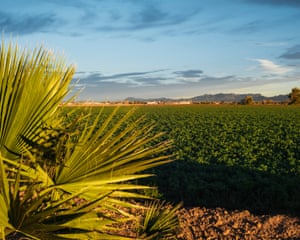
king. More than half of the town’s 94,000 acres are bushy blue-green
fields growing the crop.
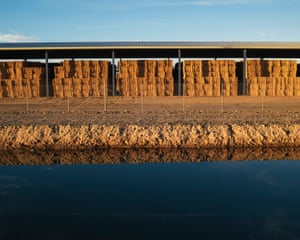
Massive industrial storehouses line the southern end of town, packed
with thousands upon thousands of stacks of alfalfa bales ready to be fed
to dairy cows – but not cows in California’s Central Valley or
Montana’s rangelands.
Instead, the alfalfa will be fed to cows in Saudi Arabia.
The storehouses belong to Fondomonte Farms, a subsidiary of the Saudi
Arabia-based company Almarai – one of the largest food production
companies in the world. The company sells milk, powdered milk and
packaged items such as croissants, strudels and cupcakes in supermarkets
and corner stores throughout the Middle East and North Africa, and in
specialty grocers throughout the US.
Each month, Fondomonte Farms loads the alfalfa on to hulking metal
shipping containers destined to arrive 24 days later at a massive port
stationed on the Red Sea, just outside King Abdullah City in Saudi
Arabia.
Alfalfa at Fondomonte Farms in Vicksburg, Arizona
With
the Saudi Arabian landscape there being mostly desert and alfalfa being
a water-intensive crop, growing it there has always been expensive and
draining on scarce water resources, to the point that the Saudi
government finally outlawed the practice in 2016. In the wake of the
ban, Almarai decided to purchase land wherever it is cheap and has
favorable water conditions to produce enough feed for its 93,000 cows.
In 2012, they acquired 30,000 acres of land in Argentina, and in
2014, they bought their first swath of land in Arizona. Then, in 2015,
they bought 1,700 acres in Blythe – a vast, loamy, agricultural
metropolis abutting the Colorado river, where everything but the alfalfa
seems cast in the hue of sand. Four years later, the company owns
15,000 acres – 16% of the entire irrigated valley.
But what business does a foreign company have drawing precious
resources from a US desert to offset a lack of resources halfway around
the globe?
What Fondomonte Farms is doing is merely a chapter in the long story
of water management in the west, one that pierces the veil on the
inanities of the global supply chain – how easy it is to move a
commodity like alfalfa, or for that matter lettuce or clementines or
iPhones, across more than 13,000 miles of land and sea, how much we rely
on these crisscrossing supply lines, and at what cost to our own
natural resources.
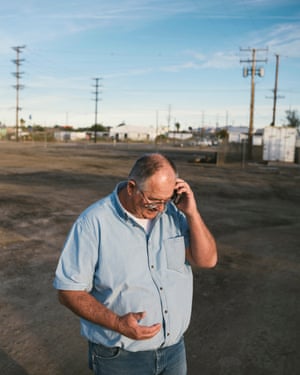
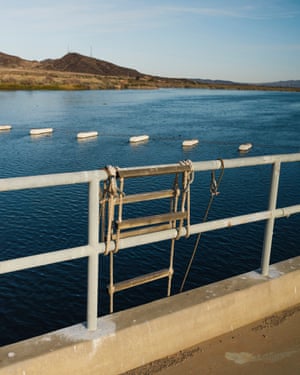
JR Echard, assistant manager of the Palo Verde Irrigation
District. The Colorado river as seen from the PVID Diversion dam in
Blythe, California
An astonishingly good rate
Though
Blythe is a desert, it is adjacent to the lower Colorado river, a river
that supplies water to roughly 40 million people and irrigates 4m acres
of land.
Bart Miller, Western Resource Advocates’ healthy rivers program
director, says that over the last 80 years, due to the growth of
proximate cities such as Denver, Los Angeles and Phoenix and the
expansion of large-scale farms, demands on the river have steadily
climbed. The river is also shrinking due to climate change. It has
endured a nearly two-decade-long drought, with only waning rain and
snowpacks to supply its flow. As a result, the river is at a record low.
The state of the Colorado river can be traced, in part, to a water
claim approved by the federal government all the way back in the 1800s
when a British gold rush-era prospector named Thomas Blythe first laid
eyes on the desert expanse adjacent to the rushing Colorado river and
submitted a water claim application to the federal government.
That 1877 water claim, now owned by the Palo Verde Irrigation
District, ensures that Blythe has “unquantified water rights for
beneficial use”; in other words, as much water as those living and
farming within the district could possibly need in this water-scarce
region, and for free.
The Palo Verde Irrigation District is not allowed to sell the water –
not to the company Calistoga, say, for bottled water, but not to their
farmers, either. Blythe farmers are thus only charged to cover the water
district’s overhead – $77 an acre a year, an astonishingly low rate.
In other places, people are charged according to how much water they
use and are thus incentivized to use less. In Blythe, no matter how much
he uses, a farmer gets his water for a cheap, flat rate.
Alfalfa fields and storage warehouses at Fondomonte Farms
Advertisement
It’s
no surprise, then, that Fondomonte chose to set up shop here. While
Saudi Arabia has enacted laws to manage their water resources, in the US
we are still governing our water based on compacts made in the 1800s –
before the western cities had boomed, before suburban sprawl, before
factory farming and a global supply chain and, of course, before climate
change. Water from the Colorado might be limited, but in Blythe, while they still have it, it’s there for the taking.
Getting the water from the river to Blythe is a complicated
engineering feat. “It’s a really unique system,” explains JR Echard,
assistant manager of the Palo Verde Irrigation District, as he traces
how the water moves throughout the valley on a map on his office wall.
“We’re in the desert,” Echard said, “but we live next to a massive
river and have rights to it.” Thomas Blythe might have appeared crazy to
want to build an empire of agriculture out here in the desert but, in
Echard’s eyes, Blythe was on to something.
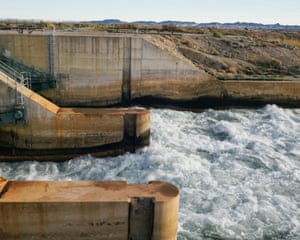
The Colorado river powers a meticulously managed system of canals and
dams. Southern water districts like Palo Verde estimate their
constituents’ water needs and submit corresponding orders to the Parker
and Hoover dams upstream which then release the requested water as
though turning a great industrial tap. Once in Blythe, the diverted
water moves downward into the valley below with the help of gravity and
into a 250-mile system of canals that wind through 100,000 acres of
cropland.
The canals are outfitted with electronic gates that can be opened and
closed with the click of a mouse from the Palo Verde Irrigation
District’s offices.
The Diversion dam on the lower Colorado river, regulated by the PVID
Advertisement
In
California, everyone’s after whatever water they can get. Because of
the low supply, the Palo Verde Irrigation District is currently three
years into a 30-year fallowing contract – when farmers are paid not to
plant a portion of their fields so the water can instead be sent to
cities – with the Metropolitan Water District, which supplies water to
big cities like San Diego and Los Angeles.
Fondomonte inherited a fallowing contract, so they are restricted
from planting a portion of their land each year. This drives the company
mad, an employee whom I will call Jim, told me. He asked not to be
named for fear of reprisal from Fondomonte. Alfalfa-hungry Fondomonte
would prefer to plant every inch.
Despite its agricultural prowess, 23% of Blythe residents live in
poverty (compared with 12% nationally). The town is home to 21,000
people – 6,000 of whom are incarcerated in one of the town’s two state
prisons. “The prisons were supposed to bring economic development to the
city,” Echard told me on our way back from the dam as we sped alongside
one of the primary canals. “But it hasn’t done much at all.”
Fondomonte, on the other hand, has been a boon. “Everyone wants to be
working here,” Jim told me. Not only does the company employ more than
100 locals full-time – as compared with the part-time or seasonal labor
found on most farms – and with 401ks, vacation and health insurance, but
they also support local farmers by purchasing their alfalfa to add to
their bales and ship overseas.
“There are a lot of exporters here,” Jim said of US farmers and farm
operations selling their crops to overseas markets. “They have been
exporting from here for 30 or 40 years. I don’t see how this farm is any
different.”
“The Saudis, they’re here buying up at a good price,” Echard
explained. “They’re just the same as everyone else. They buy local. It’s
a shot in the arm for the economy.”
A field of alfalfa in Blythe, California
But is it an outrage?
Advertisement
The
thing about alfalfa is that it’s perennial; you can grow it all year
and stagger the planting in the fields so that there’s nearly always a
new crop of alfalfa ready to be cut as well as planted. Once it’s cut,
it keeps growing, and they cut it again. A crop can last up to five
years, but Fondomonte generally rips up and replants after two or three;
any longer than that and the alfalfa grows more stem-heavy, and thus
drops in quality.
Each day on their massive, gated farm headquarters, Fondomonte
employees take samples of the alfalfa and test its quality: the higher
the ratio of leaves to stems, the better the quality, and thus the
better the milk the cows will produce.
“Almarai only wants the highest quality,” Jim explained. He broke
open a bale with his hands as if tearing off a piece of bread. The
outside of the alfalfa was brown, but just inside, was a vivid and
surprising green.
Fondomonte employs some of the most hi-tech mechanisms big ag has to
offer – computer programs that combine with satellite and drone imagery
to delineate the soil characteristics of each speck of land, drones take
videos of production in progress, and the company is currently
improving their own system of intra-farm canals and electronic gates so
that they can irrigate each field with the touch of a button from behind
a computer screen in the office. It’s all part of their ongoing effort
to maximize their efficiency and crop quality, thus their profit, thus
their empire in Saudi Arabia – perhaps, eventually, here as well.
“If it’s raining,” the employee told me, the farm manager “can just
farm from behind his desk”. They are entirely self-sufficient, and have
expertise in constructing a hi-tech alfalfa empire having already done
it in Saudi Arabia.
The storage barns at Fondomonte Farms and a PVID irrigation ditch in Blythe, California
Advertisement
Dan
Putnam, an alfalfa expert and UC Davis professor, explained US-grown
alfalfa has long been shipped overseas, long before Almarai. Alfalfa is
the third largest economic product in the US, but only 4% is exported
annually. In the western states, however, which are high producers close
to shipping ports to major export markets like China, Saudi Arabia and
Japan, about 15% is exported each year. These high-export states are
also the states that happen to be grappling with drought, meaning that
the most water-strapped states are shipping much of their water
overseas, in the form of alfalfa.
When Almarai first began purchasing land in the western US,
environmentalists, and many average citizens, were outraged. “Saudi Hay
Farm in Arizona Tests State’s Supply of Groundwater,” said an NPR
article in November of 2015. “Saudi Arabia is Outsourcing its Drought to California,” wrote Gizmodo.
Yet Putnam takes umbrage with the outrage over alfalfa exports. Why,
he wonders, are people so much more outraged over alfalfa using water
here only to be shipped overseas, what about almonds, a water intensive
crop of which 70% of California’s harvest is shipped overseas. Or
oranges? Or lettuce?
I suggested to him that it might have something to do with the fact
that alfalfa isn’t seen as food – it’s just a plant, a mega-crop
divorced, in common perception, from its value as food. But as the basic
element of a larger food chain of the dairy and meat industry, alfalfa,
Putnam claims, is critical.
“I have a T-shirt,” he told me. “Alfalfa: ice-cream in the making.”
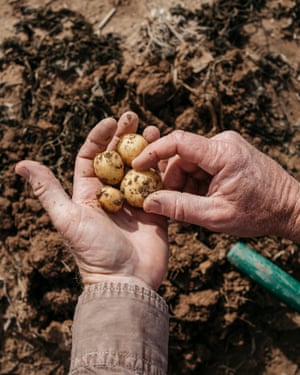
Grant Chaffin, owner of Chaffin Farms (left). The baby potatoes grown at Chaffin Farms, Blythe
Putnam, along with many farmers I spoke to, urges people to consider
how much water crisscrosses the globe in the current supply chain. It’s
not just alfalfa, and it’s not just agriculture. People will find goods
at the cheapest prices, and companies in areas with unstable resources
will relocate elsewhere.
While it’s hard to then make a clear calculation of exactly how much
US water is being poured into alfalfa and then shipped overseas (some
evaporates, some filters back into the soil, some is deposited back into
the river downstream) it’s clearly not nothing. But who knows how long
it will last. “For the survival of that country,” Putnam said of Saudi
Arabia, “they will look to other parts of the world.”
On our way back from the dam to the district offices, Echard drove me
up along the access roads to get a panorama of the canals, and past
some bright fields of alfalfa. We then drove to a part of valley where,
in partnership with various environmental organizations, the Palo Verde
Irrigation District had planted a large grove of trees to revive some of
the habitat that once stretched so abundantly along this part of the
Colorado. In August, he told me, it can be 115F (46C) outside, but under
this canopy of trees, it might be 20 degrees cooler.
“Here in the middle of the desert, we’ve got a little forest,” he
said, proudly. Like the river, this forest, too, is a manmade
environment; man’s footprint is everywhere.
As we drove back to the office, I pointed out some nice bushy trees
along the canal. “Oh, those are saltcedar,” Echard said. An invasive
species from Asia that drain the water table and leave salt deposits in
the soil, which destroys the other plants. “No one wants it,” he said,
as he yanked the truck into gear and headed back out again amid the
bright carpets of alfalfa stretching in all directions.
At this critical time…
… we can’t turn away from climate change. For The
Guardian, reporting on the environment is a priority. We give climate,
nature and pollution stories the prominence they deserve, stories which
often go unreported by others in the mainstream media. At this critical
time for our species and our planet, we are determined to inform
readers about threats, consequences and solutions based on scientific
facts, not political prejudice or business interests. But we need your
support to grow our coverage, to travel to the remote frontlines of
change and to cover vital conferences that affect us all.
More
people are reading and supporting our independent, investigative
reporting than ever before. And unlike many news organisations, we have
chosen an approach that allows us to keep our journalism accessible to
all, regardless of where they live or what they can afford.
The
Guardian is editorially independent, meaning we set our own agenda. Our
journalism is free from commercial bias and not influenced by
billionaire owners, politicians or shareholders. No one edits our
editor. No one steers our opinion. This is important as it enables us to
give a voice to those less heard, challenge the powerful and hold them
to account. It’s what makes us different to so many others in the media,
at a time when factual, honest reporting is critical.
Every
contribution we receive from readers like you, big or small, goes
directly into funding our journalism. This support enables us to keep
working as we do – but we must maintain and build on it for every year
to come
I think spring has arrived. I see the dew in the mornings, and the 5 inch garlic pocking through the soil in the back yard. I must get out and see if the soil is ready for planting. I wish I had some more bark mulch but so far no company has made a free delivery, and the soil has absorbed all the goodness from it.
As my one tenant is packing to leave after failing to pay his rent on time, another is being interviewed. Yes, the pickings are slim, and we may even have to consider a short term tenant. We are also considering putting in some extra kitchen cupboards in the suite kitchen and I got an estimate for the upstairs kitchen. Honestly, I don't know if it would be a good selling feature, or I am simply tired of the black countertops that are from the 90's. I would love to have cupboards that go up to the ceiling. I would love to have more space at a time when I should be downsizing.
I am realizing that a condominium may be a very hard adjustment for us, so I keep plugging away at this house where Deborah grew up in and ultimately left us by taking her life.
I feel remorse for not getting out to the graveside more often, I feel remorse over not calling my mom more often in the care home she is in, in Florida, I feel that I have failed my three remaining daughters by not securing in them the knowledge of the Hungarian language. I am also getting antsy over the soon arrival of my grad-daughter. I must prepare and be the best grand-mother I can be. Will it come naturally, I wonder?
Last night we went out for schnitzel at a local pub with a friend of mine, and my now youngest daughter joined us. I found the food great, but the noise was almost unbearable. A hockey game was in progress, and all the Canuck's fans were out. Thankfully, they won in overtime shoot-out, so many folks went to bed happy last night.
As we prepare to say good-bye to these Japanese students tomorrow, I can only wonder what the rest of the year will be like.
Jo
Cameron, 71, has a rare genetic mutation that keeps her from feeling
pain or anxiety, according to a new scientific report. Researchers hope
the finding can help develop more effective treatments for pain.CreditCreditMary Turner for The New York Times
She’d
been told that childbirth was going to be painful. But as the hours
wore on, nothing bothered her — even without an epidural.
“I
could feel that my body was changing, but it didn’t hurt me,” recalled
the woman, Jo Cameron, who is now 71. She likened it to “a tickle.”
Later, she would tell prospective mothers, “Don’t worry, it’s not as bad
as people say it is.”
It was only recently — more than four decades later — that she learned her friends were not exaggerating.
Rather, there was something different about the way her body experienced pain: For the most part, it didn’t.
Advertisement
Scientists believe they now understand why. In a paper
published Thursday in The British Journal of Anaesthesia, researchers
attributed Ms. Cameron’s virtually pain-free life to a mutation in a
previously unidentified gene. The hope, they say, is that the finding
could eventually contribute to the development of a novel pain
treatment. They believe this mutation may also be connected to why Ms.
Cameron has felt little anxiety or fear throughout her life and why her
body heals quickly.
“We’ve never come
across a patient like this,” said John Wood, the head of the Molecular
Nociception Group at University College London.
Scientists
have been documenting case studies of individuals who experience little
or no pain for nearly 100 years. But the genetic mutation that seems to
be responsible for Ms. Cameron’s virtual painlessness had not been
previously identified.
The study
emerged amid major developments in the emotionally charged debate over
how to responsibly treat pain. On Thursday, New York State filed one of the most sweeping legal cases yet against the Sackler family, which owns Purdue Pharma, the maker of the opioid OxyContin.
And it was yet another reminder that we need less addictive alternatives for chronic pain, said Dr. Stephen G. Waxman, a neurologist at Yale and the author of “Chasing Men on Fire: The Story of the Search for a Pain Gene.”
Dr. Waxman was not involved in the recent paper but he also studies
people who have rare mutations that alter their experience of pain.
Advertisement
“Each
of these mutations teach us something, and point to a particular gene
as a potential target for new and more effective pain medications,” he
said.
The
sequence of events that led scientists to investigate Ms. Cameron’s
genes began about five years ago. She was living a happy, ordinary life
on the banks of Loch Ness in Scotland with her husband, she said. After a
hand operation, a doctor seemed perplexed that she was not experiencing
any pain and did not want painkillers.
“I
guarantee I won’t need anything,” Ms. Cameron recalled telling Dr.
Devjit Srivastava, a consultant in anesthesia and pain medicine at a
National Health Service hospital in northern Scotland and one of the
authors of the paper.
Because
she doesn’t feel pain, Ms. Cameron burns herself quite frequently. The
scars tend to go away quickly, she said, something else scientists are
planning to investigate.CreditMary Turner for The New York Times
Image
Because
she doesn’t feel pain, Ms. Cameron burns herself quite frequently. The
scars tend to go away quickly, she said, something else scientists are
planning to investigate.CreditMary Turner for The New York Times
A
few follow-up questions revealed that Ms. Cameron was unusual. At 65,
she’d needed to have her hip replaced. Because it had not caused her
pain, she had not noticed anything was amiss until it was severely
degenerated. Cuts, burns, fractures — these did not hurt either. In
fact, it often took the smell of burning flesh or her husband
identifying blood for her to notice something wrong. She also reported
that eating Scotch bonnet chili peppers left only a “pleasant glow.”
Advertisement
Dr.
Srivastava referred her to University College London’s Molecular
Nociception Group, a team focused on genetic approaches to understanding
the biology of pain and touch. They had some clues for her. In recent
decades, scientists have identified dozens of other people who process
pain in unusual ways. But when Dr. James Cox,
a senior lecturer with that group and another author of the new paper,
inspected her genetic profile, it did not resemble that of others known
to live without pain.
Eventually he
found what he was looking for on a gene the scientists call FAAH-OUT.
All of us have this gene. But in Ms. Cameron’s, “the patient has a
deletion that removes the front of the gene,” he said. Additional blood
work confirmed this hypothesis, he said.
Ms.
Cameron said she had been shocked by the interest in her case. Until
her conversation with Dr. Srivastava, pain was not something she thought
about. Perhaps it helped that even though she burned and cut herself
quite often, her injuries rarely left scars — something else that
scientists believe is connected to the mutation.
A number of articles have been written
about parents of children with similar conditions. Many live in fear
that without pain, their children won’t learn how to avoid hurting
themselves. Her parents never made it an issue, she said. She suspects
this may be because she inherited the mutation from her father.
“I can’t remember him needing any painkillers,” she said. “I think that’s why I didn’t find it odd.”
Unfortunately,
because he died before the discovery, it will remain unknown whether he
carried the mutation. Her mother does not share it. Neither does her
daughter. Her son “has the same microdeletion in FAAH-OUT, but does not
have the other mutation that confers reduced FAAH function,” Dr. Cox
said.
Advertisement
In other words, her son shares some, but not all, of her pain insensitivity.
Scientists
are also intrigued by Ms. Cameron’s extraordinarily low anxiety level.
On an anxiety disorder questionnaire, she scored zero out of 21. She
cannot recall ever having felt depressed or scared.
“I am very happy,” she said.
In
retrospect, she sees how her genetic disposition may have aided her at
work. After years as a primary-school teacher, she retrained to work
with people with severe mental disabilities. Erratic, aggressive
behavior never riled her, she said.
But
though having this mutation may sound like a dream, there are
downsides. One is that she is quite forgetful; prone to losing her keys
and her train of thought midsentence. The other is that she’s never felt
the “adrenaline rush” that other people talk about, she said.
The
researchers said they would now focus on trying to better understand
how FAAH-OUT works so that they can design a gene therapy or other pain
intervention around it. Turning a discovery of this sort into an actual
pain or anxiety treatment requires many steps, many years and many
millions of dollars. It’s rare for a product to emerge.
But
it’s not unprecedented, Dr. Waxman said. As a reminder of how an
individual with an unusual genetic makeup can shape the future of
medicine, he pointed to statin drugs.
“They
were developed largely on the basis and discovery of incredibly rare
families where everyone was having heart attacks in their 20s,” he said.
Whether it will be Ms. Cameron’s mutation or another individual’s
mutation that directs the future of painkillers, it’s too early to say.
“But
I’m reasonably confident that the lessons we are learning from the
genes involved in pain will lead to the development of an entirely new
class of pain medications,” he said.
'Families have been torn apart': Truck driver who caused Humboldt Broncos bus crash gets 8-year prison term
Social Sharing
Jaskirat Singh Sidhu pleaded guilty to charges stemming from 2018 crash that killed 16, injured 13
Jason Warick · CBC News ·
Jaskirat
Singh Sidhu is taken out of court by the RCMP following his sentencing
for the Humboldt Broncos bus crash in Melfort., Sask. (Kayle Neis/The Canadian Press)
The
truck driver who caused the deadly Humboldt Broncos bus crash a year
ago was sentenced to eight years in prison when he appeared in a
Melfort, Sask., court Friday.
Jaskirat Singh Sidhu, 30, pleaded guilty in January to 29 counts of dangerous driving causing death or bodily injury.
On
April 6, 2018, Sidhu failed to stop his semi-trailer truck at a highway
intersection, killing 16 people and injuring 13 on the bus carrying the
Broncos junior hockey team and others en route to a playoff game.
Judge Inez Cardinal empathized with the victims' families as she read out her sentencing decision.
"Most find the pain unbearable," she said. "Families have been torn apart."
Jaskirat Singh Sidhu arrives in court Friday morning for his final sentencing. (Jason Warick/CBC)
Sidhu
received a sentence of eight years for each fatality and five years for
each person injured, to be served concurrently (at the same time).
Cardinal
said no case in Canada resembles this one due to the staggering number
of dead and injured. She said she knows this has been difficult, but
hopes Sidhu and the victims' loved ones can now heal.
CBC Reporter Jason Warick will be tweeting live from court. On mobile? Click here.
She also noted that a just sentence was important to establish public confidence in the system.
Families
burst into tears after the sentence was delivered. Some immediately
walked out, while others stared at the judge's empty seat at the front
of court.
'Hole in our lives'
Chris Joseph, former NHL
player and father of deceased player Jaxon Joseph, said the judge made a
reasonable decision. But nothing is going to bring his son back.
"I knew I was going to be disappointed no matter what," he said. "There's no number that would have made me happy."
Joseph told reporters he and his family vow to campaign to make the roads safer.
"We're
not getting Jaxon back, so we want to create change," he said. "That's
what we will be focusing on from now on going forward, because that's
all we have."
Meanwhile, Toby Boulet, said the death of his son
Logan has caused irreparable mental and physical anguish for the rest of
his family's life.
"We have a hole in our lives until we also
pass," he said. "We're searching somewhere, somehow for the new normal.
And we're continuing to do that."
Boulet's son had told his
parents he wanted to become an organ donor when he died. What became
known as the Logan Boulet Effect spread across the country as nearly
100,000 Canadians signed up to become organ donors after hearing he had
signed his own donor card.
"We want people to become organ donors," he said. "We're not done. We're all in."
Ultimately, he said it's difficult to forgive the man that killed his son.
"We
do believe that Mr. Sidhu is remorseful," he said. " But the bottom
line is that he was negligent and caused the death of my son and deaths
of 15 other people."
Outside of court, Sidhu's uncle read a
statement to reporters, expressing their sympathy to the families and
the understanding they have shown throughout.
Chanan Singh Sidhu, uncle of truck driver
Jaskirat Singh Sidhu, expressed his family's 'sincere sympathy' to the
families of those killed and injured in the Humboldt Broncos bus crash
00:0000:58
Chanan Singh Sidhu, who lives in Britain, thanked Canadians for their 'support, sympathy and understanding'. 0:58
According to an agreed statement of facts, Sidhu was solely responsible for the crash.
A forensic collision report found he didn't brake at the intersection of Highway 335 and 35 before hitting the bus.
The
report said Sidhu's view of the intersection was not impeded by any
environmental factors like trees near the road or sun in his eyes.
Anita
Dahlgren and Mark Dahlgren, parents of bus crash survivor and former
Humboldt Broncos player Kaleb Dahlgren, walk into court for the
sentencing of truck driver Jaskirat Singh Sidhu in Melfort. (Kayle Neis/The Canadian Press)
In
court, the judge noted that Sidhu was preoccupied with a flapping tarp
covering his truck's load and failed to notice road signs. She said a
person is not innocent simply because the consequences of their actions
are not forseeable.
She said Sidhu had many chances to stop but
didn't, and said it was inconceivable he missed the intersection's many
large signs, including flashing lights.
"Seconds matter," said Cardinal. "Attention to the road matters."
In
a statement, the Humboldt Broncos said the team is thankful that the
matter is over and that Sidhu is being held to account for his actions.
"This
past year has been extremely difficult," said team president Jamie
Brockman in a news release. "Having this legal matter settled and the
sentencing complete is a big step in the healing process for the
survivors, grieving families, our organization and the community of
Humboldt and surrounding area."
Failed to stop
During
sentencing arguments last month, prosecutor Healey said Sidhu had more
than enough time to slow down and stop, stating it would have taken the
semi more than 100 metres to stop, but the first warning of the
intersection was 400 metres away. Healey said Sidhu entered the
intersection "like a rocket."
He said it wasn't a case of
momentary distraction, noting there were four signs in advance of the
intersection, as well as a large stop sign with a flashing light. A car
was also stopped directly across from him on the highway, waiting for
the Broncos bus to pass.
Chris
Beaudry, former assistant coach of the Humboldt Broncos, walks into the
Kerry Vickar Centre for the sentencing of truck driver Jaskirat Singh
Sidhu. (Kayle Neis/The Canadian Press)
The
courtroom was set up in a school gymnasium to accommodate a large crowd.
Before court opened, Bronco supporters handed out packs of tissue to
families in the gallery, many of them wearing team jerseys with their
loved ones' name on the back.
Crown prosecutor Thomas Healey had asked for a 10-year prison sentence.
One
of Sidhu's lawyers, Mark Brayford, cited dangerous driving cases with
sentences of 18 months to four years, but didn't make an explicit
recommendation.
More than 90 victim impact statements were
presented to the court by friends and families of victims during an
emotional week-long sentencing hearing.
The emotional statements
detailed the anguish families have gone through over the past year.
While some families said they forgive Sidhu for his role in the crash,
others said they would never be able to.
Sidhu lived in Calgary
and was working for a Calgary-based trucking company at the time of the
crash. The owner of the company, Sukhmander Singh faces eight counts of
failing to comply with safety and log-keeping regulations.
According
to his lawyer, Sidhu had started working for a small trucking company
three weeks before the crash. He spent two weeks training with another
person in the vehicle and spent the final week driving alone.
Because
of the crash, the Saskatchewan government has promised to make several
changes to the intersection where the crash occurred, from rumble strips
to better signage. It also pledged millions for improvements at other
intersections.
At the time of the crash, training for Canada's 300,000 semi drivers had been optional everywhere except Ontario.
Broncos
parents, families of other victims, academics, and drivers themselves
petitioned and pushed for change. Training became mandatory in
Saskatchewan last week, and will become mandatory across Canada in 2020.
It's
likely Sidhu will be deported. He grew up on a farm in India and
followed his girlfriend to Canada in 2013 and is a permanent resident,
not a citizen of Canada.
Under federal law, a permanent resident convicted of a crime that holds a maximum sentence of at least 10 years may be deported.